Amazon Vendor vs Amazon Seller: What Really Sets Them Apart
"Vendor" and "Seller" aren't two names for the same thing. They're two different business models with Amazon, with different implications for price, margin and control over the customer — and picking the wrong one costs more than it looks.
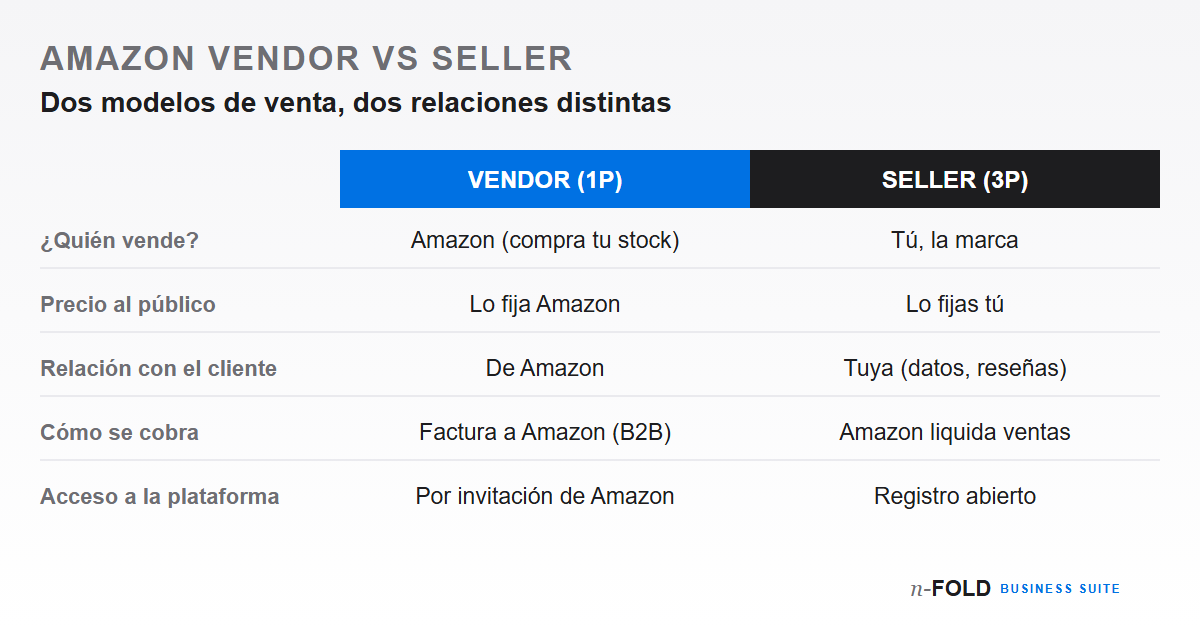
It's common to mix up the terms, partly because in everyday conversation both sound like "I sell on Amazon." But the business mechanics behind them are different, and with them, so are the margin, who controls the price, and who owns the customer data.
Amazon Seller (3P): you sell, you decide
On Seller Central, the brand — or the distributor — remains the one selling. Amazon acts as a marketplace: you list your catalogue, set the sale price, manage (or outsource via FBA) the logistics, and get paid directly for each sale minus Amazon's commission. Access is open: any company can register and start selling within days.
Amazon Vendor (1P): Amazon buys from you, Amazon sells
On Vendor Central, Amazon stops being a marketplace and becomes your customer: it buys stock from you through Purchase Orders at an agreed wholesale price, then resells those products under its own name, setting the retail price and appearing as the seller to the end customer. Access isn't open — you get in by Amazon's invitation, not by self-registration (we cover this in more detail in how to become an Amazon Vendor).
The differences that actually matter when deciding
Beyond who appears as the seller, there are three differences that change how the business is managed day to day:
- Price control. As a Vendor, Amazon can lower the retail price on its own — even below what the brand would like — to win the Buy Box or move inventory. As a Seller, you decide the price at all times.
- Customer relationship. As a Vendor, buyer data (who they are, what reviews they leave, how they repeat-purchase) stays on Amazon's side. As a Seller, the brand keeps that relationship and that data.
- How you get paid. As a Vendor, you invoice Amazon like any B2B customer, with its own payment terms and conditions. As a Seller, Amazon settles sales made to the end consumer directly, deducting its commission.
What if you don't have to choose just one?
Many brands end up operating a hybrid model: part of the catalogue sells as a Vendor — usually the higher-turnover products, where the volume Amazon moves as a distributor is worth having — and another part stays as a Seller, especially on SKUs where controlling price or the customer relationship matters more than volume. It's not the simplest option to manage, but it's often the one that balances both worlds best.
The operational side that doesn't change with the model
Whether you sell as a Vendor, as a Seller, or in a hybrid model, you still need to stay on top of demand forecasting, stock replenishment and who holds the Buy Box on each ASIN. The difference is that as a Vendor, those variables are managed through Purchase Orders and data arriving via SP-API, not manually from your own dashboard — which, on large catalogues, makes Amazon Vendor management software that automates that tracking even more necessary.
Operating as an Amazon Vendor and want to automate forecasting, replenishment and Buy Box tracking per ASIN?
See the Amazon Vendor moduleIf you're interested in understanding how this data connects with Amazon in practice, you can read what the Amazon SP-API is, the interface Vendor Central (and Seller Central) uses to exchange orders, inventory and reports automatically.