How to Become an Amazon Vendor: Requirements and Process
There's no sign-up form. There's no "apply" button. Being an Amazon Vendor is, by design, an invitation Amazon makes — not a decision a brand makes on its own.
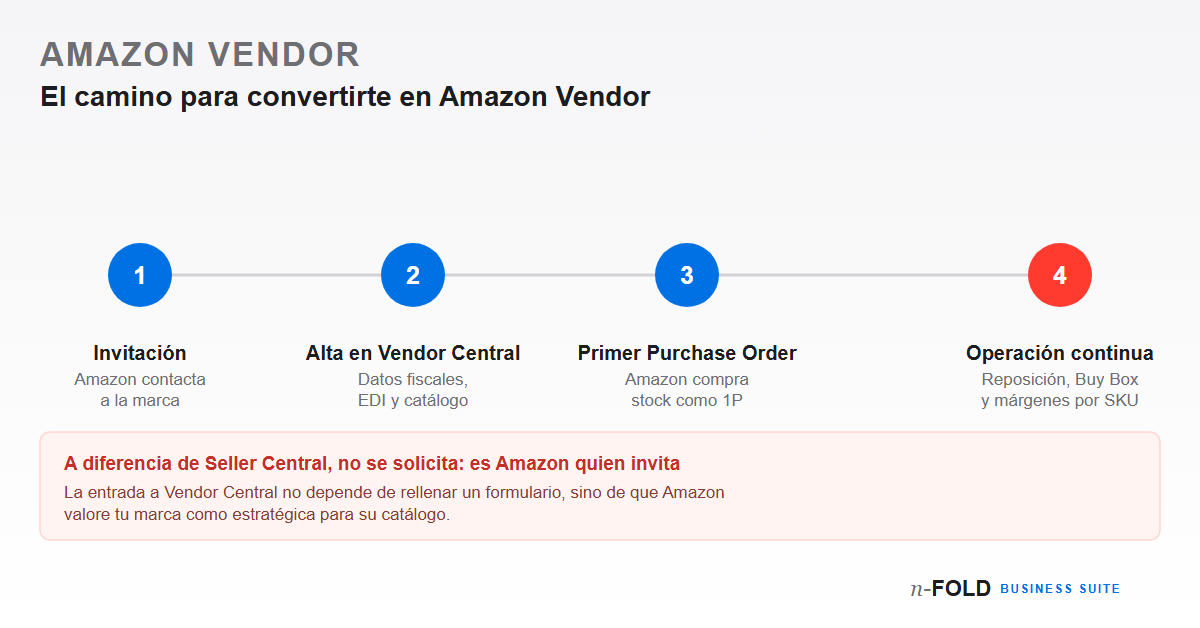
It's one of the questions we hear most from brands growing on Amazon as a Seller who start hearing about Vendor Central: how do you switch to the other side? The answer usually surprises people, because it doesn't depend on filling anything in — it depends on Amazon deciding your catalogue is worth having as a distributor.
What Amazon Vendor actually is
Vendor is the model in which Amazon acts as a wholesale distributor of your brand: it buys stock from you at an agreed price through Purchase Orders, then resells those products under its own name, setting the retail price, managing shipping and appearing as the seller to the end customer. This is the model known as "1P" (first-party), as opposed to the "3P" (third-party) model on Seller Central, where the brand remains the one selling directly.
Why Amazon invites, rather than the brand applying
Amazon has no need to open Vendor Central access to just any brand — it's interested in selecting catalogues that bring volume, category relevance or exclusivity. The invitation usually arrives by email from an Amazon Vendor Manager, and it's normally preceded by signals the brand has already generated on its own: consistent sales as a Seller, strong product ratings, reliable stock availability, or a presence in a category where Amazon wants to strengthen its direct catalogue.
There are also narrower access programmes, such as Vendor Express in certain categories or marketplaces, but they aren't the general route and their availability changes frequently. The direct invitation remains the standard.
What to prepare before receiving (or accepting) the invitation
Accepting isn't free: it means giving up control of the retail price and the direct customer relationship, in exchange for volume and the visibility of selling as Amazon. Before saying yes, it's worth being clear on:
- Production and stock capacity. Amazon buys through Purchase Orders with specific deadlines — missing them directly affects your vendor scorecard.
- Margin after the wholesale price. The price Amazon pays as a distributor is lower than the retail price; you need to work out whether the volume compensates for the lower unit margin.
- EDI or integration capacity. Vendor Central runs on structured data exchange (orders, invoices, confirmations) — past a certain volume, doing it by hand stops being viable.
- Chargebacks and compliance. Amazon financially penalises labelling, packaging or deadline issues — you need to know the rules before operating, not after the first penalty.
The process once the invitation arrives
After accepting, onboarding to Vendor Central involves registering the brand's tax and banking details, loading the catalogue with its logistics information (dimensions, weight, EAN/UPC codes) and setting up the order exchange method, either EDI or the manual interface for smaller catalogues. From there, Amazon starts sending Purchase Orders based on its own demand forecast, and the relationship becomes recurring: orders, confirmations, shipments and invoicing, cycle after cycle.
What really changes when operating as a Vendor
The least visible part from the outside is operational: unlike Seller Central, where the brand decides when and how much to sell, on Vendor Central it's Amazon that sets the order pace, based on its own forecast. That shifts the management burden onto the brand — you need to watch your own demand forecast, anticipate stockouts, control that the resale price isn't eating your margin, and catch Buy Box losses in time, all per ASIN and often across catalogues of hundreds of SKUs.
Already operating as an Amazon Vendor and want to stop managing replenishment and margin by hand? Discover our Amazon Vendor management software.
See the Amazon Vendor moduleIf you want to dig into the underlying differences between the two models before deciding whether accepting an invitation is worth it, you can also read Amazon Vendor vs Amazon Seller: what really sets them apart, or understand how communication with Amazon gets automated once you're in with what the Amazon SP-API is.