What Is the Amazon SP-API and What Is It For
Every tool that promises to "sync automatically with Amazon" is, underneath, talking to the same front door: the Selling Partner API. Understanding what it is helps tell a real integration apart from a simple report exporter.
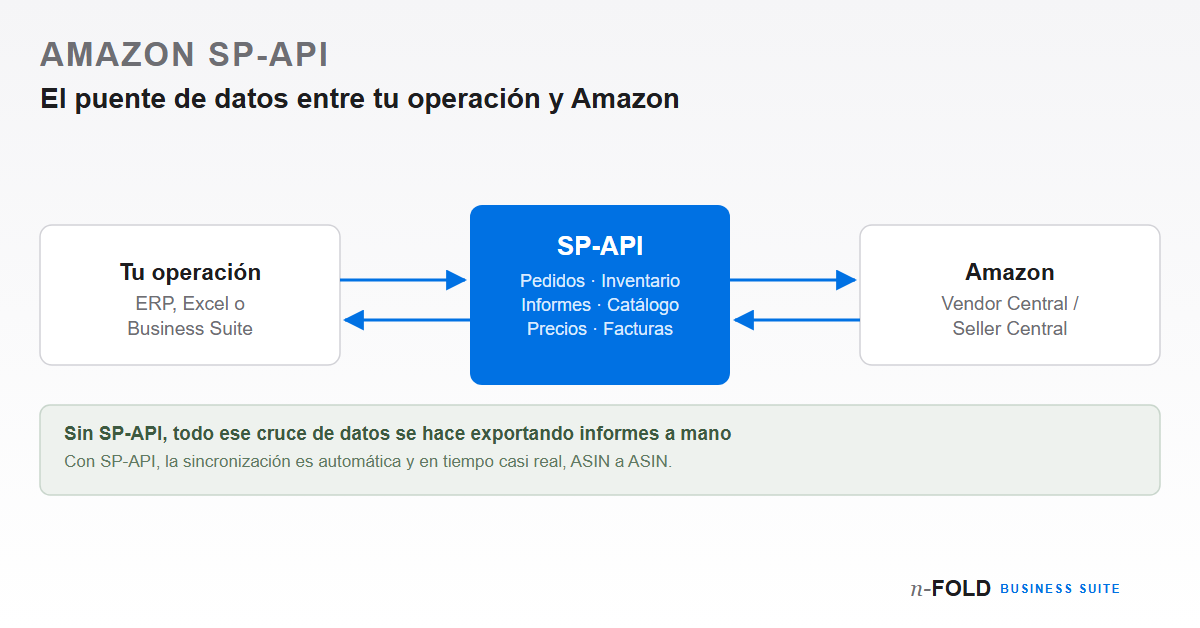
If you manage an Amazon Vendor or Seller account, you've probably heard of the SP-API without necessarily knowing exactly what it is, beyond "something technical developers use to connect with Amazon." That short explanation is correct but incomplete: understanding what it actually does helps you judge which management tools are actually worth using.
The short definition
The Selling Partner API (SP-API) is Amazon's official interface for external systems to exchange data with Vendor Central and Seller Central programmatically, without relying on manually exporting reports from the web panel. It replaced the older MWS (Marketplace Web Service) and Vendor API, unifying access to both account types into a single interface.
What data it lets you move
In practice, the SP-API covers pretty much everything that used to require manual checking inside Vendor or Seller Central:
- Orders. Incoming Purchase Orders (Vendor) or customer orders (Seller), their status and confirmation.
- Inventory. Stock levels at Amazon's fulfilment centres, per ASIN.
- Reports. The same data you see in Brand Analytics or performance reports, but downloadable automatically and on a schedule.
- Catalogue. Creating and updating product listings, attributes and images.
- Pricing. Agreed cost price (Vendor) or sale price (Seller), and Buy Box competition.
- Invoicing. Issuing and tracking invoices tied to Purchase Orders.
Why it matters, beyond the technical side
The real difference between manual and automated management isn't whether the data gets "looked at," but how often and how reliably it's updated. A manually exported report reflects a snapshot of that moment; a few hours later, it's already stale. With SP-API access, order, inventory and pricing data can sync on a near-continuous cycle, letting you react to an imminent stockout or a Buy Box loss the same day it happens, not the following week when someone exports the report again.
Why not every brand uses it directly
Accessing the SP-API isn't as simple as requesting a key: Amazon requires developer registration, OAuth authentication, signing every request, and respecting rate limits that vary by data type. For a team without dedicated technical staff, building and maintaining that integration in-house usually doesn't pay off against the business volume it manages.
That's why the most common route — and the one most Amazon Vendor management tools on the market use — is relying on Amazon Vendor management software that already has the SP-API integration built and maintained, and consuming the data already processed and cross-referenced with the rest of the operation, instead of touching the API directly.
Want orders, inventory, pricing and Buy Box on your Amazon Vendor account synced automatically via SP-API?
See the Amazon Vendor moduleIf you're interested in the business context behind this integration, you can also read Amazon Vendor vs Amazon Seller or, if you're not yet operating as a Vendor, how to become an Amazon Vendor.